Ancient Egyptian Art History: A Journey Through Timeless Creativity

When we think of Ancient Egypt, images of pyramids, grand tombs, and hieroglyphs often come to mind. But the history of Ancient Egyptian Art is far richer. It spans nearly 3,000 years of intricate craftsmanship, religious symbolism, and cultural evolution. Egyptian art reflects a deep connection to their beliefs, society, and the notion of timelessness. In this overview, we’ll explore key periods, the unique characteristics of Ancient Egyptian Art, and why it still captivates us today.

You can also watch my YouTube video about Ancient Egyptian Art History | Overview and Characteristics

Ancient Egyptian Art Summary

Ancient Egyptian Art Across Millennia

Ancient Egyptian Art spans over 2,800 years, starting with Egypt’s unification in 3100 BCE and continuing until Alexander the Great conquered Egypt in 332 BCE. This extraordinary timeline highlights how Egyptians valued artistic traditions. Cleopatra’s reign, often viewed as ancient history, was actually closer in time to modern smartphones than to the construction of the Great Pyramids.

Egyptian art developed through several key periods: the Early Dynastic, Old Kingdom, Middle Kingdom, New Kingdom, and Late Period. Each phase brought new artistic innovations while maintaining a core set of themes connected to religion and the divine.

Core Themes: Tombs, Temples, and Timelessness

Three dominant themes define Ancient Egyptian Art: tombs, temples, and timelessness. These concepts deeply influenced their art, reflecting their beliefs about life, death, and the afterlife.

  1. Tombs: Much of the art we have today comes from tombs. Egyptians believed art and objects in tombs helped the dead transition to the afterlife. Tomb art wasn’t just decorative—it served a spiritual purpose.
  2. Temples: Egyptian temples also played a major role in artistic development. These spaces were adorned with statues, carvings, and murals that honored the gods. Temples were built to last forever, just like the art inside them.
  3. Timelessness: Egyptians believed their art should endure. They followed strict conventions, believing any change in artistic style could disrupt the divine order. This commitment to timelessness made Ancient Egyptian Art consistent for millennia.

Defining the Canon of Ancient Egyptian Art

Ancient Egyptian Art followed a specific canon, a set of rules that guided how subjects were depicted. Rather than focusing on realism, the Egyptians prioritized order and symbolism. This canon ensured all art adhered to a common standard.

  • Composite views: Figures in Ancient Egyptian Art were shown from multiple angles. Faces and legs appeared in profile, while torsos faced forward. This allowed each body part to be displayed fully and balanced.
  • Geometric shapes: Egyptians simplified the human form into basic shapes. Broad shoulders formed a triangle that narrowed into a slender waist. These geometric designs reinforced the sense of structure.
  • Idealism: The canon demanded perfection. Kings, gods, and important figures were depicted as youthful, strong, and athletic, even if they weren’t in real life. This idealism reflected power and immortality.
  • Hierarchy of scale: Size indicated importance. Pharaohs and gods appeared larger than other figures to emphasize their significance.

The Power of Pharaohs

One of the earliest pieces of Ancient Egyptian Art, the Palette of Narmer, exemplifies these artistic conventions. This ceremonial object, dating back to the Early Dynastic period, commemorates the unification of Upper and Lower Egypt. The figures are idealized, shown in composite view, and arranged using geometric shapes. The palette also includes hieroglyphs and symbols of power, such as crowns and weapons, to highlight the authority of the pharaoh.

In the Old Kingdom, Ancient Egyptian Art reached new heights with the construction of the Pyramids of Giza. These monumental tombs reflected the Egyptians’ focus on the afterlife and desire for eternal preservation. The statue of Kafre Enthroned, found near one of the pyramids, captures the essence of timelessness. Carved from diorite, this figure was designed to endure forever, providing a place for Kafre’s spirit if his body were destroyed.

In contrast, the Seated Scribe (The Seated Scribe photograph – Rama, CC BY-SA 3.0 FR) shows how non-royal individuals were portrayed differently in Egyptian art. While still created for the afterlife, the scribe appears more natural, with sagging muscles and a relaxed pose. Unlike pharaohs, everyday individuals like the scribe were not idealized. This difference highlights how the canon applied mainly to royalty and the gods.

Akhenaten’s Revolutionary Impact on Ancient Egyptian Art

The New Kingdom brought about dramatic changes in Egyptian art during the reign of Akhenaten. He rejected the traditional polytheism of Egypt and introduced a monotheistic religion centered around the sun god Aten. Akhenaten’s reign sparked a new artistic movement known as the Amarna style.

Akhenaten statue (Ismoon, CC BY-SA 2.5)

This style broke away from the rigid canon that had dominated for centuries. Figures became more fluid and curvaceous. Akhenaten himself was depicted with both masculine and feminine traits, mirroring the androgynous nature of the god Aten. This radical departure from the norm represented Akhenaten’s desire to reshape Egyptian society and art. However, this style only lasted 17 years. After Akhenaten’s death, his successor Tutankhamun restored the traditional artistic conventions.

(Akhenaten statue: Ismoon, CC BY-SA 2.5)

Ancient Egyptian Art’s Legacy: The Late Period and Beyond

During the Late Period, Egypt fell under foreign rule from groups such as the Nubians, Persians, Greeks, and Romans. Despite this, Ancient Egyptian Art continued to reflect its core values of timelessness and order. Foreign influence blended with traditional Egyptian techniques, creating a unique synthesis of styles.

One of the most fascinating examples is the mummy portraits from the Roman era. These lifelike portraits, painted on wood panels and attached to mummies, merged Roman painting techniques with Egyptian burial practices. The art of mummification continued, and the desire to preserve the human form remained, demonstrating how deeply rooted these beliefs were in Egyptian culture.

Final Thoughts on Ancient Egyptian Art

Ancient Egyptian Art is more than beautiful—it’s a reflection of a society deeply committed to maintaining order, balance, and divine connection. From the grandeur of the pyramids to the intricate carvings found in tombs and temples, Egyptian art was crafted to last forever. It wasn’t just meant to be admired but served as a bridge between the physical and spiritual worlds.

The themes of tombs, temples, and timelessness reveal the Egyptians’ focus on immortality. Their art aimed to preserve life beyond death and maintain cosmic order. Whether studying massive stone statues or detailed wall paintings, we still see the influence of Ancient Egyptian Art today.

By understanding their artistic canon and the symbolism behind it, we can appreciate the lasting legacy of this ancient civilization. The art of Ancient Egypt continues to captivate us, reminding us of the human desire for legacy and the quest for eternal life.

Pieter Bruegel the Elder’s Hunters in the Snow Analysis

Pieter Bruegel the Elder's Hunters in the Snow, 1565
Pieter Bruegel the Elder’s Hunters in the Snow, 1565

We are all familiar with the great artists of the Italian Renaissance – names like Da Vinci, Michelangelo, and Raphael easily come to mind. However, the Renaissance wasn’t confined to Italy alone; it flourished in various parts of Europe, including Flanders and other Dutch regions.

In this article, we will delve into the world of one of the Northern Renaissance’s most renowned artists, Pieter Bruegel the Elder, and famous painting Hunters in the Snow. His name deserves recognition alongside those of his Italian counterparts, as his work profoundly influenced Dutch painters like Franz Hals and Pieter Paul Rubens, and contributed to the Dutch Golden Age of painting.

You can also refer to my related YouTube video: Pieter Bruegel the Elder and Analysis of Hunters in the Snow

Context of Hunters in the Snow

The Renaissance Amidst Religious Turmoil

During the Renaissance, Europe was marked by religious conflicts, including Martin Luther’s Reformation and the Catholic Church’s Counter-Reformation.

This religious divide fractured Christendom and led to a century-long civil war between Protestants and Catholics. This tumultuous period posed a challenge for artists, as their primary patron, the Church, was divided. Despite this uncertainty, there was a significant exchange of intellectual and artistic ideas between Northern and Southern Europe.

One crucial idea that made its way north was humanism, championed by the scholar Erasmus. Humanism emphasized the goodness and value inherent in humanity itself, shifting the focus from deities to humans. It celebrated human tendencies and the divine within people, drawing inspiration from Greek and Roman ideals and elevating the human form.

These intellectual ideas fused with Italian Renaissance art concepts, resulting in Dutch artists adopting principles like a focus on underlying structure, human anatomy, and the manipulation of perspective.

The Distinctive Northern Renaissance

Northern European art during the Renaissance differed from its Italian counterpart. While Italian art often centered around Christian themes, Dutch artists sought different patrons among the wealthy elite. Consequently, many Dutch paintings eschewed Christian motifs and turned to “genre scenes” – depictions of everyday life. These genre scenes celebrated the mundane, emphasizing the significance of human experiences.

These Dutch genre scenes often conveyed moral messages through symbolism. For example, seemingly mundane scenes, such as a butcher’s stall or a money changer’s workspace, revealed deeper layers of Christian symbolism and moral narratives, encouraging viewers to look beyond the surface.

Pieter Bruegel the Elder: A Moralist’s Brush

The Painter and The Connoisseur, c. 1565, possibly Bruegel’s self-portrait

One notable figure in the Northern Renaissance was Pieter Bruegel the Elder, not to be confused with his son, Pieter Bruegel the Younger.

Pieter Bruegel the Elder was renowned for his moralistic genre scenes and his profound influence on the Dutch Golden Age of painting. Among his masterpieces, Hunters in the Snow stands out.

Analysis of Hunters in the Snow: Celebrating the Mundane


Painted in 1565, Hunters in the Snow is an oil painting on wood, measuring approximately four by five feet.

Despite its grand scale, the scene it portrays is far from grandiose. Peasants return from a hunting expedition with meager spoils, weariness etched on their faces. The frigid winter landscape is painted in shades of blue, gray, and dull colors, evoking the desolation of late January.

The composition’s strong diagonal lines draw the viewer’s eye to the background, where people appear tiny, like ants. Yet, in true Dutch fashion, there’s more beneath the surface…

Discovering Hidden Stories and Celebrating Mundanity in Bruegel’s Hunters in the Snow

Bruegel often incorporated churches into his works, subtly hinting at their presence with steeples. But it’s not the focus of his Hunters in the Snow painting…

In Hunters in the Snow, keen observers will notice various activities – ice skaters, curling, a hockey game, and children sledding. Each figure becomes a part of the narrative, showcasing the everyday lives of people in the 16th century Dutch countryside.

What makes this painting truly remarkable is its celebration of the mundane. It brings dignity and purpose to everyday tasks, elevating them to the realm of art.

Suddenly, the burdens of our daily lives seem a little lighter. Hunters in the Snow encapsulates the essence of humanism, demonstrating that even in the darkest of winters, there is hope and honor in the ordinary.

Exploring Deeper Meanings of Hunters in the Snow

In Pieter Bruegel the Elder’s Hunters in the Snow, we engage with a masterpiece that not only illustrates the harsh realities of winter but also elevates the human spirit. It acts as a poignant reminder that beneath the surface of the everyday lies an extraordinary beauty waiting to be unveiled.

This painting exemplifies the profound impact art can have in elevating the mundane and revealing the significance within the ordinary.

What does this masterpiece signify to you? What other hidden narratives can you uncover within its intricate details? Share your thoughts and your favorite Dutch artists in the comments below.

The 5 Impressionism Art Characteristics

Impression, Sunrise painting by Claude Monet
Impression, Sunrise by Claude Monet (credited for the naming of the Impressionism art movement)

What is it about the Impressionism art movement that makes it one of the most influential and popular movements? The characteristics of Impressionism art were new, exciting, and radical. In many ways, the art was rebellious from classical art prior to Impressionism.

In this article I outline five of the main Impressionism art characteristics that will not only help you understand this art on a deeper level but also help you easily identify Impressionism art when you see it:

  1. Quick, loose brush strokes
  2. Bright paintings
  3. “En plein air” (Painting Outside)
  4. Relative color
  5. Clearer picture from further away

5 Impressionism Art Characteristics

Quick, loose brush strokes

The first characteristic is the quick, loose brush strokes. This is probably the most commonly talked about and easily recognized of the Impressionism art characteristics. When you zoom in on an Impressionist piece, you can see the artist’s hand with individual, small, and loose brush strokes. This is because the artist often doesn’t have a lot of time to complete these images, which I’ll explain in the third characteristic. 

Close-up of Woman with a Parasol - Madame Monet and Her Son painting by Claude Monet
Close-up of Woman with a Parasol – Madame Monet and Her Son by Claude Monet

The focus of Impressionist artworks is not on the fine details. Instead, Impressionists are trying to capture a moment – an “impression”. And in so doing, they move quickly, without much detail, as the artist’s hand moves across the canvas with quick brush strokes. This is why you can often see individual strands of the paintbrush being used in an Impressionist piece.

Bright paintings

The second of the five Impressionism art characteristics I want to focus on is the brightness of the paintings from this movement. Now, colors and brightness differed by artist and different times during the movement, but in general you’ll see a lot of brightness in Impressionism art. 

To really understand why this was groundbreaking at the time, let’s jump back in art history. The art movement prior to Impressionism was Realism. The artists during Realism typically used blacks, grays, and browns, which resulted in darker, more earthbound paintings. Also, you can look back to the Baroque period. Baroque art is full of darker tones. In fact, a lot of Baroque artists painted a dark brown or black “ground” color on their canvas. This was the primer that they painted on their canvas before painting the rest of the painting on top of this dark brown or black.

(See an analysis of Caravaggio’s The Entombment of Christ for an example of Baroque art.)

Painting of The Bridge at Villeneuve-la-Garenne by Alfred Sisley (1872) to show the bright colors of Impressionism art.
The Bridge at Villeneuve-la-Garenne by Alfred Sisley (1872)

Instead, Impressionist artists used light “ground” colors or even unprimed canvases. In addition, they used hues from the light spectrum in their paintings – red, orange, yellow, green, blue, indigo, and violet. Finally, they didn’t blend their colors on the canvas. They would often paint complementary colors next to each other to give the painting a more vibrant, alive feeling.

So, using hues from the light spectrum on this light “ground” and not blending the colors, but often painting complementary colors next to each other, created colorful, bright, vibrant paintings.  

“En plein air” (outdoors painting)

Painting of Claud Monet painting "en plein air"
Claude Monet Painting by the Edge of a Wood by John Singer Sargent (1885)

The third Impressionism art characteristic is called “en plein air”, which refers to painting outdoors. Paintings prior to Impressionism were usually completed in some sort of studio. Studios were controlled environments, often with models and apprentices involved.

Impressionists decided to take their canvases outside, which was unheard of at the time. The Impressionists wanted to capture a moment in time and the feeling or “impression” of that moment. In order to do so, they needed to be on-scene. So, they painted “en plein air”, meaning out in the open. Therefore, you get a lot of landscapes and outdoors scenes from Impressionism. 

Relative color

The fourth characteristic of Impressionism art is the use of relative color. This is the opposite of “local color”. The term “local color” refers to the color an object would naturally appear in neutral, white light. Another way to think of “local color” is the colors that we typically attribute to things – grass is green, snow is white, the sky is blue.

Impressionist artists didn’t like to use “local color”. In capturing the moment they were painting, they captured objects and colors as they saw them. The artists wanted to depict objects in the light that they saw at certain times of day or in certain environments. So, these objects didn’t necessarily have the colors you would naturally attribute to them, but what they looked like as the Impressionists were painting “en plein air”. Water could be purple. Grass could be blue. A mountain range orange. This is called “relative color”.

Clearer picture from further away

Finally, one of my favorite Impressionism art characteristics is how the paintings become clearer the further away you are physically from the canvas. The closer you view Impressionism art, the less clear the painting becomes and the more chaotic it gets. As you get close to the canvas, you see the artist’s hand in every individual brush stroke and glob of paint. But the painting lacks detail. As you move further away from the painting, the scene, the emotion, and the details become clearer.

The Artist’s Garden in Giverny painting by Claude Monet  (Zoomed in)
The Artist’s Garden in Giverny by Claude Monet (Zoomed in)

I think this is a great connection with how people typically experience the world as we age. As we get older, we tend to realize how chaotic and messy life is. Yet, somehow, the entire messy picture makes more sense.

The Artist’s Garden in Giverny painting by Claude Monet
The Artist’s Garden in Giverny by Claude Monet (1900)

Viewing Impressionism art in person

I love the way Impressionist paintings make me feel. The idea of capturing a moment in time before it disappears and having it last forever is beautiful. We will never see the most beautiful second of that sunset from last weekend again. But maybe we can capture that impression with a painting.

I also love the experience of seeing Impressionist art in real life. The ability to get close and see the artist’s hand and paint brush at work and then step back as everything comes together is amazing. It’s a wonderful experience.

Understanding the Impressionism art characteristics covered in this article will help you better understand the art from this movement. You should also be able to easily identify an Impressionist piece the next time you see one. Look for these five characteristics and see if you notice any others.

To see how the Impressionism movement fits within art history, you can download this condensed western art history timeline. You can also check out these art history movements and periods videos to dive in deeper to each movement or period.

6 Famous Self-Portraits from Art History (Art Selfies)

The first photographed selfie is said to have been captured in 1839. (Although the word selfie didn’t originate until 2002.) With today’s front-facing camera, millions of selfies are taken every day. Who hasn’t taken a selfie? But even before the first photographed selfie, art selfies (known as self-portraits in art history) have been around for centuries. Even if you aren’t an art lover, or just beginning your journey, you’ll likely recognize these famous self-portraits from art history. 

What is a self-portrait in art?

The art selfie, or self-portrait, is when an artist creates or paints an artwork of themselves. Throughout art history, artists have had the same motivations or reasons for their self-portraits that we tend to have with our modern day selfies. These include portraying our best selves, expressing emotions, showing a unique part of our identity, or giving a snapshot of an impactful experience in life.

6 famous self-portraits from art history

This article dives into six famous self-portraits. Hopefully you’ll see how these self-portraits connect to the selfies you see all around you today. Narrowing my list down to just six was extremely difficult. If your favorite didn’t get on the list, write it in the comments at the bottom of the article.

Sofonisba Anguissola’s Self-portrait at an Easel (1556)
Sofnisba self-portrait painting

Anguissola was a female renaissance artist. A female artist was very rare during this time period, as men ruled the art sphere. She became an artist after her father taught her, he himself being a famous artist. 

This specific self-portrait painting is Renaissance in character. She portrays herself as subdued and calm, yet confident in her craft. You can see she is painting an image of Mary and Christ. By painting herself in the act of painting, she makes it clear that she is an artist. She shows off her skills with the details in the clothing, the colors, and the emotion in The Madonna and Christ child. Perhaps the emotion in the painting portrays her longing for children that she never ends up having. 

Caravaggio’s Self-Portrait as Bacchus (1593)
Self-portrait as Bacchus painting

Caravaggio is a famous Baroque artist with incredibly dramatic and powerful art. He completed Self-Portrait as Bacchus in 1593. During this time, records show that Caravaggio had recently arrived in Rome. Shortly after his arrival, he got sick and spent six months in the hospital with what was most likely malaria. And this is the image he painted of himself to represent what he went through. 

In this famous self-portrait, Caravaggio portrays himself as Bacchus. Bacchus is the Greek god of wine, fertility, religious ecstasy, festivity and theatre, and more. Basically the god of having a grand time! So, you can see a little bit of Caravaggio’s personality as he portrays himself as Bacchus. 

Upon further analysis, you’ll notice the sickness in Caravaggio’s (or Bacchus’s?) face and skin. Some of the side effects of malaria include jaundice skin, yellowing eyes, and pale lips, which you will notice in the painting. So yes, he looks like he’s having a good time, but he also looks strained from sickness.

Perhaps Caravaggio’s Self-Portrait as Bacchus represents today’s hospital recovery selfie. That selfie of someone recovering in a hospital with a nice cold drink in one hand and the other hand showing a thumb’s up. Like, “I just went through something terrible, but all is good. I’m ready to party again.”

Judith Leyster’s Self-Portrait (1630)
Judith Leyster self-portrait painting

Judith Leyster is a Northern Baroque artist. In fact, she’s one of the first successful female artists from the Netherlands. In the north, they liked to paint genre scenes – typically scenes of the interior of regular people doing regular everyday activities, which you see in this self-portrait. 

Leyster most likely did not paint in the outfit she portrays herself in. Just look at that collar – very restrictive. But, dressing herself up like this makes her seem like a more serious artist. She may be trying to portray herself as well-off in order to appeal to her audience of patrons and buyers. In addition, the extravagance of her clothing lets her show off her talents. The lace, the silk, and other details are impressive.

The painting within the painting is of a young fiddler in a typical genre scene. (Common within Northern Baroque art as mentioned above) Leyster holds her paintbrush and palette, to clearly show herself as the artist. 

Finally, check out that gaze. She is looking at you in a way that says, “Hey, I’m good at what I do.” But also, she does so with a sly smirk. This painting was likely an inspiration for a young female artist somewhere.

Rembrandt’s Self-Portrait, 1660 (1660)
Rembrandt self-portrait painting

You cannot talk about famous self-portraits without mentioning Rembrandt. He is probably the most famous self-portrait artist, painting over 40 throughout his career. 

This self-portrait was completed in 1660. Around this time, Rembrandt went bankrupt. In addition, he lost a lot of friends and people in the art world. In fact, a lot of his artwork was destroyed at an art auction (terrible!). So, he’s kind of in despair at the time of this painting.

The focus of the painting is definitely Rembrandt, particularly his face. Everything else, even his clothing, is dark and dreary. Now, focusing on his face you can see wrinkles and discoloration in the skin. The look on his face is one of dejected acceptance. Perhaps despondence is the right word. His hair is graying, and he looks tired and sad. On the other hand, his image portrays this  feeling of acceptance. Like he’s okay with the situation and he’s ready to move forward. You can see the resolve that he has, which is really powerful. 

Elisabeth Louise Vigée Le Brun’s Self-Portrait (1790)
Le Brun self-portrait painting

Vigée-Le Brun was a very successful artist. She was the court painter for Marie Antoinette while she lived at the Palace of Versailles, and painted over 40 portraits of the famous French queen. She painted in between the Rococo and Neoclassical art movements, and she balanced those two movements perfectly.

When you look at her, she shows herself as young, vibrant, talented, and of the upper class. She shows off her talent in the way she creates different textures and details. Look at the contrasting textures between the lace collar and the velvet sash. Look at the sheerness of her cap and her amazing hair.

Like some other artists in self-portraits, she’s holding her tools in her hands to solidify herself as an actual artist. Females like to do this because they weren’t taken as seriously as artists. Just like Judith Leyster, she glances at you with this air of confidence. Yet another empowering art selfie that likely helped motivate other women artists. 

Gustave Courbet’s Le Désespéré (1841)
Gustave Courbet's Le Desespere painting

The last of my 6 famous self-portraits is by Gustave Courbet in 1845. It’s called Le Désespéré, which means hopelessness or despair. The painting was completed earlier in his career when he had not yet proven himself as a successful artist. It’s romantic in style, although Courbet does go on to help start the Realism movement. 

The emotion in this painting is intense. Perhaps this is how he felt at the time, after dropping out of law school and struggling to gain footing in the art scene. He was frequently being rejected. Later in his much more successful career, he would say, “I was made to suffer despair in my youth”, which we can clearly see in this self-portrait. With his big, wide eyes and his hands grasping at his hair, you can see the despair and hopelessness. Yet, you can still see that incredible talent. Just notice the strong diagonal lines, intense details in each strand of hair, and the unique romantic style of high contrast between light and dark in this high-drama painting. This is a talented artist.

Famous self-portraits compared to modern day selfies

So, when you walk through art museums and pass those famous self-portraits, perhaps you might stop next time. Ask yourself, “What is the artist showing or teaching me in this self-portrait?” Or, “How does this self-portrait connect to the artist’s story?” Similarly, the same goes for selfies that you see today from friends or others. Are they trying to tell you something? Are they crying for help? Are they portraying themselves at their best to tell you something? What does it have to do with their life story? We can listen. We can empathize. And we can try to figure out how we can help or connect with them on a deeper level.

How to Understand Mondrian’s Composition with Red Blue and Yellow

Mondrian's Composition with Red Blue and Yellow painting
Composition with Red Blue and Yellow by Piet Mondrian (1930)

Composition with Red Blue and Yellow is a post-WWI piece completed in 1930 by Piet Mondrian. At first glance, the painting may seem unimpressive to the average viewer. It seems boring and simple. But, after you understand some background information and dive into some analysis, you may become impressed. If nothing else, you may gain some understanding and appreciation for this painting.

*Just an FYI: I get commissions for purchases made through links at the end of this post, at no extra cost to the buyer. By clicking and buying through these links, you’ll help me to continue providing educational art history content.  

What is the background of Composition with Red Blue and Yellow?

After WWI, art one got a little weird. Many people were trying to process what had just happened. How could humanity have done such a tragic thing to themselves? 

A lot of the artists were processing this trauma in some really interesting ways. Various modern art movements challenged the status quo, as they tried to grapple with their questions. One of the main questions circulating within art was, “What even is art?” Some of the art movements during this time period that you may be familiar with are Surrealism, Dada, and Cubism. These movements pushed the boundaries of what art was thought to be.

De Stijl art movement and Composition with Red Blue and Yellow

Portrait of Piet Mondrian
Piet Mondrian (1872-1944)

One of the movements around this time of pushing the status quo within art was the De Stijl Art Movement. Piet Mondrian was one of the leaders of this movement, and Composition with Red Blue and Yellow is perhaps one of his most well known paintings. Although many of his paintings look similar, this piece has some impressive aspects, which I dive into in my analysis. To set the stage for the analysis, let’s learn a little more about De Stijl Art.

What is De Stijl Art?

De Stijl simply means “the style” in Dutch. Now, many of the other art movements around this time were getting a little crazy with the elements of art and principles of design. In contrast, the leaders of the De Stijl art movement decided to go back to the basics of form and color. In doing so, they decided to focus on three things in their art:

  1. Horizontal and vertical lines. No diagonals were allowed.
  2. The primary colors of red, yellow, and blue along with black and white
  3. Asymmetrical balance. They wanted to have a feeling of balance but they did it in an asymmetrical way. 

Although still radical and abstract, the visual composition of the De Stijl art movement was simplified when compared to the other movements of the time. The straight lines and primary colors are what De Stijl artists decided were the universal forms of expression. With this in mind, let’s dive into a deeper analysis to bring out the power of Piet Mondrian’s Composition with Red Blue and Yellow.

What is the meaning of Composition with Red Blue and Yellow

Let’s go ahead and apply each of the three things mentioned above to Composition with Red Blue and Yellow

Mondrian's Composition with Red Blue and Yellow painting
Composition with Red Blue and Yellow by Piet Mondrian (1930)

Horizontal and vertical lines

Being true to De Stijl art, you only see vertical and diagonal lines. What’s incredible about these lines is Mondrian never used a ruler in his paintings. Look at how straight these lines are. In our digital age, it’s hard to imagine that something like this could have been created without a computer, but when you zoom in, you can see the brush strokes. You can see the artist’s hand. Also notice how the lines create a heaviness on the left. With the thickest line on the left side and the lines crossing in the bottom left, your eyes are drawn to this area. 

Now focus on the three horizontal lines in the piece. The longest one extends across the painting towards the bottom. Perhaps you can view this line as the horizon, separating the earth beneath and the sky above. (Horizon and horizontal have the same root word). The horizon often symbolizes hope. Furthermore, it grounds and connects us to the earth that we know, while begging us to think about what exists in the skies, beyond this earth. The unknown. 

Then we have two vertical lines in this piece. The vertical lines lead our eyes upwards towards the sky and the unknown. So, this ascension of the vertical is kind of juxtaposed with the earthly of the horizontal. 

Primary Colors 

First, focus on the color blue down in the left hand corner. Blue is a color of calm. A color of equilibrium and the color of the earth as it appears from space. So, you can consider blue a very earth-bound color. 

In the bottom right hand corner, the little yellow rectangle reminds me of the sun and represents joy and happiness. Yellow brings a bright energy to the painting and offsets the calm blue. And remember, when you mix yellow and blue you get green. Another earthbound color beneath the horizon. 

Finally, taking over the majority of the space is the red. The red helps create a sense of balance in this clearly asymmetrical piece. As the lines draw you toward the left and bottom corners, the red overpowers and draws you towards the opposite section of the painting. Red can represent the sunrise and sunset. Courage and passion to consider things beyond this world. 

Asymmetrical balance

Somehow this asymmetrical painting feels complete. Mondrian uses the lines and colors in a way that creates balance. In fact, Mondrian was known to hate the messiness and randomness of nature. It was something that made him really uncomfortable, so he believed that if you contemplate nature and society long enough it will become balanced. And you see that in Composition with Red Blue and Yellow. If you spend time with the painting it becomes stable and calm. The more you look at the piece, the more you get this sense of stability, calm, and balance. 

Final Thoughts

Why do we create art like this? Abstract art can sometimes help us explain and experience the emotions and feelings that we can’t put into words. For me, I love the feeling of stability that Composition with Red Blue and Yellow has, even with the seemingly unbalanced asymmetry. I crave balance and understanding, especially in the chaos of life. So, this piece brings me hope that I’ll find that feeling of stability in all the craziness.

The other thing this painting helps me understand is the idea that two opposing forces can reside in the same space and in harmony together. I love that there’s nuance in this painting. The idea that two conflicting ideas can reside together. Maybe these ideas conflict or don’t agree with each other, but in a way they balance each other out. When the horizontal and the vertical lines converge, there’s balance. When the softer blue and yellow colors contrast against the explosive red, there’s balance. For me, this is comforting.

If you have questions or want to include some of your own thoughts and analysis of Composition with Red Blue and Yellow, please reach out to me or comment below. I’d love to hear your thoughts.

Also, if you really like Piet Mondrian’s art and the ideas in this article, one of my favorite art history items in my house is my Modern Art Desserts: Recipes for Cakes, Cookies, Confections, and Frozen Treats Based on Iconic Works of Art [A Baking Book]:

For more fun art history items for your home or potential gifts for art history lovers, check out these 15 Best Gifts for Art History Lovers.

18 Best Gifts for Art History Lovers and Art Lovers

brown jest for you box
Photo by Pixabay on Pexels.com

As an art history lover myself, there’s nothing better than getting a creative art history gift for Christmas or your birthday – but it needs to be a good one! Gift giving and gift receiving can be a powerful way to build stronger relationships with friends and family, so I’m here to help. Below, you’ll find 18 of the best gifts for art history and art lovers alike. I’ve received some of these from students, friends, and family. (I’ve only included the gifts I’ve liked!). And for the rest, I’ve researched extensively to find art gifts that I still want (hint, hint to my friends and family) and that provide a variety of options.

*Just an FYI: I get commissions for purchases made through links in this post, at no extra cost to the buyer. By clicking and buying through the links in this post, you’ll help me to continue providing educational art history content.  

Best Gifts for Art History Lovers and Art Lovers Alike

1. Art Masterpieces to Color: 60 Great Paintings from Botticelli to Picasso (Dover Art Coloring Book)

Amazon image - Art masterpieces to color Amazon image
*Image courtesy of Amazon

Many art history lovers are not particularly great artists themselves (myself included). But, adult coloring is a popular trend that provides much needed relaxation and quiet time. And what’s better than coloring some of your favorite art pieces from history?

This coloring book includes 60 masterpieces. From Michaelangelo, to Claude Monet, to Vincent Van Gogh, it will be hard not to find favorites! The one-sided pages allow you to use markers, watercolors, and more. Or, you can just stick to colored pencils and crayons like I do!

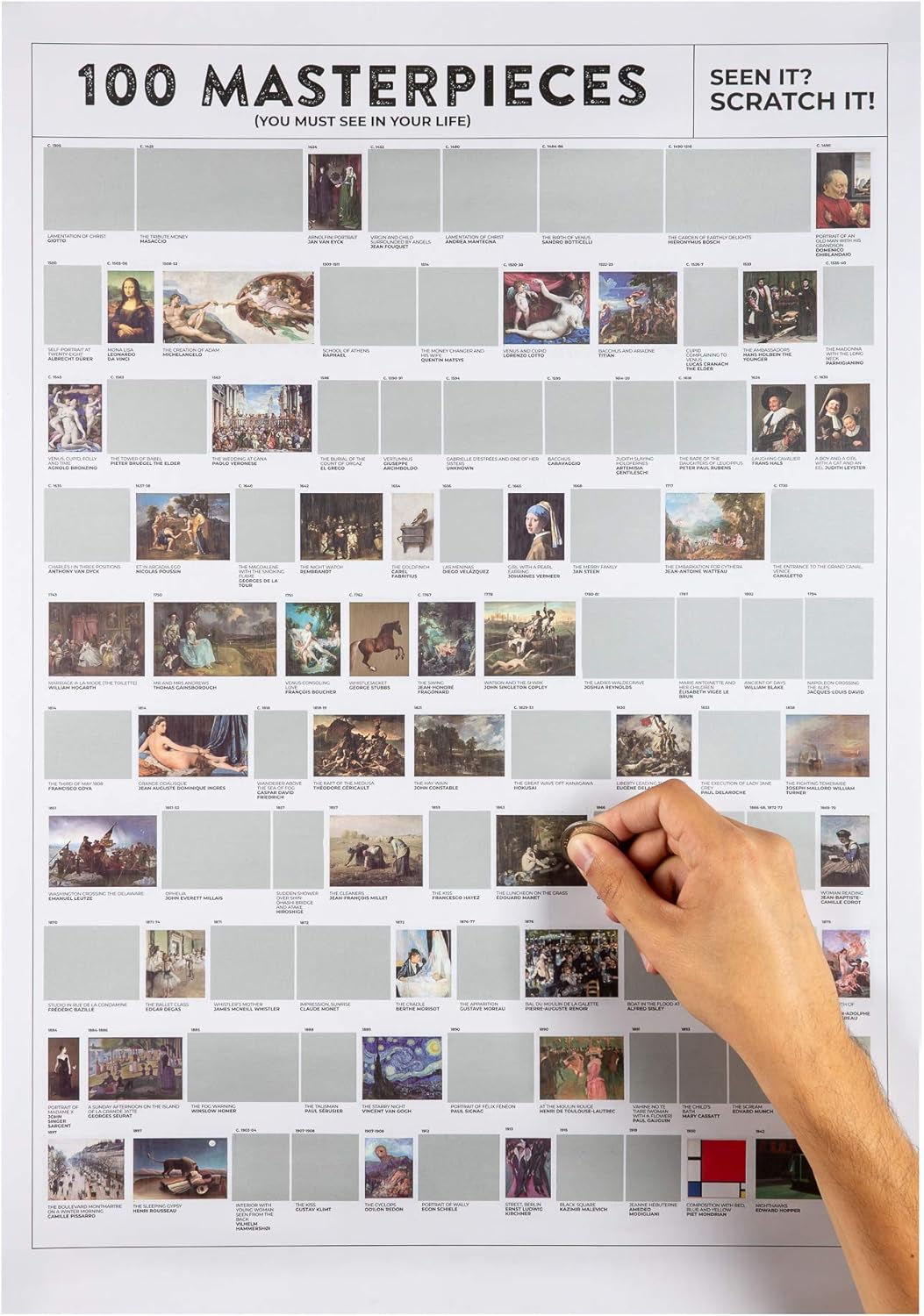
2. 100 Masterpieces Art History Bucket List Scratch Poster

Amazon image - Art history bucket list scratch poster
*Image courtesy of Amazon

Art history lovers are usually travelers. Furthermore, they love to brag about the famous museums and art pieces they have seen in person. So, this gift is perfect for your traveling art history lover to hang up and keep track of all those masterpieces they’ve seen in person.

3. Modern Art Desserts: Recipes for Cakes, Cookies, Confections, and Frozen Treats Based on Iconic Works of Art [A Baking Book]

Amazon image - Modern art desserts cook book
*Image courtesy of Amazon

This art desserts recipe book is inspired by iconic modern art pieces found in the San Francisco Museum of Modern Art (SFMOMA). They are made at the SFMOMA Rooftop Coffee Bar by the Blue Bottle Coffee Company (chef Caitlin Freeman). And don’t worry, the recipes have been adapted for at-home bakers.

Not only are the desserts world class, but also the book looks great on display in the kitchen. It’s a great gift to enable those art history lover bakers to impress their friends and family!

4. Chalier 5-6 Pairs Womens Famous Painting Art Printed Socks Casual Cotton Cool Novelty Funny Socks for Women

Amazon image - Famous painting art socks
*Image courtesy of Amazon

You can never go wrong with some fun socks as a gift. Choose from various art history masterpiece combos of 5-6 pairs. They are quality, and comfortable with average Amazon ratings of 4.8 stars on 5,000+ reviews! Probably one of the safest best gifts for art history lovers. Also, if you buying for a guy, sometimes my husband steals these socks from me and he loves them!

5. Impressionists Art Posters for Decorations (13 x 19 in, 20 Pack)

Amazon image - Impressionists art posters
*Image courtesy of Amazon

The Impressionism art movement is often the most loved movement in art history. The art from this time is beautiful to hang in homes or offices. So, a pack of 20 13×19 Impressionist art posters is another gift that is hard to go wrong with.

6. Great Nudes Heat Changing Coffee Mug

Amazon image - Great nudes heat changing coffee mug
*Image courtesy of Amazon

Okay, I just couldn’t resist including this one. When you pour warm liquid in this coffee mug, the clothed figures turn into the nudes that they are supposed to be! 

As a high school AP art history teacher, it’s always fun getting my students over the awkwardness of nudes and helping them see the beauty and importance of this aspect within art history. So this is a great one for your art history teacher friend or family member, or any art history lover!

7. Jean-Michel Basquiat. 40th Ed.

Amazon image - Basquiat book
*Image courtesy of Amazon

Basquiat is one of the most influential and important American artists in the 20th century. This hardcover book is a beautiful celebration of his art, life, and influence. If you’ve ever heard your art history lover friend or family member mention Basquiat, this gift is a great option.

8. The Arnolfini Marriage Meowsterpiece of Western Art 500 Piece Puzzle

Amazon image - Arnolfini Meowsterpiece puzzle
*Image courtesy of Amazon

The Arnolfini Portrait by Jan Van Eyck is an iconic Northern Renaissance painting. This fun puzzle is a play on that painting. Does the art history lover in your life like puzzles? Better yet, are they cat lovers too? Look no further than this gift.

9. Andy Warhol-inspired Soup Can and Crayons

Amazon image - Warhol soup can and crayons
*Image courtesy of Amazon

Ah, the classic Andy Warhol soup cans. This is a versatile gift that can be displayed on a desk, placed in the kids play room, or stuffed in the kids bag to be used on-the-go.

10. Gothic Cathedral Architecture Mug

Amazon image - Gothic cathedral mug
*Image courtesy of Amazon

There is nothing comparable to the grandeur and awe of gothic cathedrals. This is perhaps one of the best gifts for art history lovers that can’t stop talking about their experience at Notre-Dame or Cologne Cathedral. A friendly reminder of their awe-inspiring experiences as they sip their daily coffee.

11. Let It Gogh T Shirt Vincent Van Gogh Artist Funny Image Gift

Amazon image - Let it Gogh shirt
*Image courtesy of Amazon

This one is for my dad! A punny t-shirt featuring a self-portrait of one of the greatest artists of all time. My only beef is that I’m pretty sure the most common pronunciation we hear of Van Gogh’s name, and the one used in this t-shirt is not accurate. Okay, that doesn’t really matter though!

It is also important to note that it comes in three different colors for men, women, and youth. So you’ll be able to find the right one for your giftee.

12. The Story of Paintings: A History of Art for Children

Amazon image - History of art for children
*Image courtesy of Amazon

What art history lover doesn’t want to pass on their passion to their kids? I have a young one that I’m already teaching about my favorite art history paintings. This is a great book to get your little ones started with recognizing 39 of the most famous artworks over time.

13. Brief History of Art Coffee Mug – History’s Greatest Masterpieces From Da Vinci to Koons

Amazon image - Brief history of art coffee mug
*Image courtesy of Amazon

The classic art history gift. Sipping coffee, reading a book, and being reminded of masterpieces from art history on a Sunday morning? Nothing gets better than that.

14. Famous Women Artists Feminist Art History Gift T-Shirt 

Amazon image - Famous women artists t shirt
*Image courtesy of Amazon

This one is for all my feminist art history lovers out there! They’ll know these names. And they will rock this shirt with pride. There are 7 colors to choose from and sizes for men, women, and youth.

15. Show Me the Monet: A Card Game for Wheelers and (Art) Dealers

Amazon image - Show me the Monet card game
*Image courtesy of Amazon

I had to include an art history card game. I’m not a big gamer, but I’ll play this one. (Especially to appease my husband who is a big gamer.) Anything with art history involved can usually pull me away from the current book(s) I’m reading. Fun for art history lovers and non-lovers (or soon-to-be lovers) alike, it’s a trading and collecting game for some of the most famous artworks.

16. The Unemployed Philosophers Guild Vincent Van Gogh Bust Succulent Planter – Plant Holder Pot for Small Cactus, Flowers, Herbs, and More

Vincent van gogh pot holder
*Image courtesy of Amazon

I love plants. Live plants are a must-have in every room of my life (at home and at school). This Vincent Van Gogh plant holder is a perfect addition for your art history teacher’s classroom or any art lover’s home. A simple celebration of one of the most complicated and incredible artists of all time.

17. Design Toscano WU69354 Great Sphinx of Giza Sculpture – Medium, Single

*Image courtesy of Amazon

This one is for all those Ancient Egyptian art lovers. There is something captivating about Ancient Egyptian art history when you dive into it. This beautiful Great Sphinx of Giza sculpture celebrates one of the most famous landmarks of this time period. And it’s perfect for office or home decor!

18. Starry Night – Vincent Van Gogh – Cotton Woven Blanket Throw – Made in The USA (72×54)

*Image courtesy of Amazon

Get cozy with this Starry Night cotton woven blanket. With 4.8/5 stars, I’m confident you can’t go wrong with this gift for any art lover. Snuggle up, watch This Is a Robbery: The World’s Biggest Art Heist on Netflix, and sip some tea from your great nudes heat changing coffee mug. Oh, and don’t forget some art-themed cozy socks while you are at it!

These 18 gifts for art history and art lovers should have you covered. If it doesn’t, and I’m really missing one that should be on here, please let me know! I will be updating this article every year for the foreseeable future as I receive new gifts and come across new ideas that make it to my wish list. All the best in your gift giving efforts!

Neoclassical Art Period – Summary and Characteristics

The Neoclassical art period reached its height in the late 18th and early 19th century. Born in Rome, the movement spread throughout Europe and the United States. It was a return to ancient Greek and Roman art characteristics and ideals. Therefore, Neoclassical art portrayed the ideas of simplicity, reason, order, virtue and civilized society.

This article covers four important things that led to the Neoclassical art period. And in addition, the main characteristics of the art during this time.

How did the Neoclassical art period start?

There are four main things that led to the Neoclassical art movement:

  1. A pushback on the Baroque and Rococo art movements 
  2. Writings of Johann Joachim Winckelmann 
  3. Excavations of Pompeii and Herculaneum in Italy
  4. The 18th century Age of Enlightenment 

1. Neoclassicism – A pushback on Baroque and Rococo

The two preceding art movements to Neoclassicism are Baroque and Rococo. The Baroque art movement lasted approximately 150 years from 1600 to 1750. It was full of drama, emotion, and tension.

Next, the Rococo or Late Baroque art movement started in the early 1700s and lasted until the mid-to-late 1700s. Rococo built was similar to Baroque, but was more fun and frivolous. Therefore, it’s not surprising that Rococo turned its attention away from the church and Christian themes. The art became more hedonistic in a way. 

The Neoclassical art movement follows Baroque and Rococo in the late 1700s. In many ways, it was a push back to the gaudy, frivolous, and over-the-top nature of these previous movements. In fact, some of the leading figures of Neoclassicism fought against the leaders of Rococo and the French aristocracy. So, Neoclassicism art shows a stark contrast to the preceding art. It was full of simplicity, reason, and a return to order and virtue.

2. Writings of Johann Joachim Winckelmann

You can’t talk about the Neoclassical art movement without mentioning the writings of Johann Joachim Winckelmann. He  was a German art historian and archaeologist. In fact, many people believe he was the father of art history. As an art historian myself, thanks for getting us started Wincklemann! 

His writings from the mid-1700s were a deep dive into the ideals of Roman and Greek art. Winckelmann believed that art should aim for “noble simplicity and calm grandeur”. And that the only way for us to become great is to imitate the ancients. These writings had a huge impact on our return to Greek and Roman ideals, especially in art. 

3. Excavations of Pompeii and Herculaneum

In the mid 1730s and 40s, the real excavations of the ancient cities of Pompeii and Herculaneum began. These excavations included the discovery of Roman art and architecture, which revived the study of Greek and Roman art. In fact, Rome was a major stop for The Grand Tour – a traditional trip taken by European upper-class men once they reach the age of 21. This stop on The Grand Tour helped spread Neoclassicism from Rome to other parts of Europe

4. The 18th century Age of Enlightenment

Finally, the Neoclassical art period coincided with the 18th century Age of Enlightenment. This philosophical movement valued science and reason. It was a main driver of the Industrial Revolution. The ideals of individual liberty, religious tolerance, and constitutional governments were pushed. Therefore, Neoclassical artists were inspired by these ideas. They portrayed art that was civilized, reasonable, and contributed to a more orderly society.

Neoclassical art period characteristics

With the background of these four things that led up to the Neoclassical movement, it’s a little bit easier to understand the art and architecture styles of this period. As well as everything else already mentioned, the characteristics of art during this time were serious, symmetrical, orderly, virtuous, and heroic. The art often depicted characteristics from classical history, as well as political, philosophical, and religious leaders who were important to the time. The architecture became more simple and less ornate than Baroque and Rococo architecture. 

Oath of the Horatii - A Neoclassical art classic
Oath of the Horatii, David (1784)

Although some may find Neoclassical art boring, I think you can find a lot of beauty in the classic nature of the Roman and Greek art characteristics. Even though there is generally less drama and emotion, some Neoclassical artists were able to bring the intensity and drama into their painting. Although it was in a more simple fashion. I love Jacques Louis David’s paintings during the apex of Neoclassicism. (Dive into Oath of the Horatii with me, and you’ll see!) . David was considered the leader of the movement in France. His art was simple, yet dramatic and captivating. Much of his artwork eventually turned into propaganda, but his craft was incredible and impacted many students who would go on to produce great art.

If you want to see how Neoclassicism fits into the larger timeline of art history, make sure you watch my Western Art History Timeline video. You can also download my Condensed Western Art History Timeline.

How to analyze art and enjoy art museums more

One of the beauties of art is that it can connect you with people across time and culture. This connection can bring empathy, understanding, and incredible learning experiences that transform your view of the world. But it usually requires a little bit of effort in the form of art analysis. In this article, I cover three simple steps on how to analyze art. These steps will help you get more out of art and will help you enjoy your next art museum visit even more. The three steps are simple:

  1. Observe
  2. Interpret
  3. Synthesize

Let me dive into each of these further so you can really apply them. And for a more in-depth understanding of art analysis, you can watch my video on How to Analyze Art | Visual and Contextual Analysis. This video gets a bit more technical, as I talk about visual and contextual analysis, which are common terms within art analysis.

How to Analyze Art

Observing Art

This step should be obvious. To understand and connect with art, you need to sit with the art. Stop and observe. Now, you don’t need to do this with every art piece that you see. But when art catches your attention whether because it creates a strong emotional reaction, looks odd, looks beautiful, or seems familiar – stop! Even if an artwork doesn’t catch your attention, you can stop to see if you can find some sort of meaning.

Once you stop, there’s multiple ways you can observe:

  • What do you see in the art? This could include colors, shapes, lines, familiar events or people, animals, landscapes, location, etc.
  • What is the art piece’s title and date? What is the historical context or description (often found on the plaque next to an art piece, or you can look it up online)?
  • How did the artist create this art? Is it a painting, sculpture, etc.? Does it look realistic, abstract, etc.?
  • What emotions does this artwork give you?

Observing the art is just the first step. But now it gets fun.

(To understand how to observe art in greater depth, download my Art Analysis PDF.)

Picture of a woman showing us how to analyze art.

Interpreting Art

After observing the art, now it’s time to interpret. This involves asking and answering the why’s? Why did the artist use these colors? Or, why does the painting have this title? Why is this particular person depicted in the artwork or why was the artwork created during this year? And maybe one of the best questions you can ask – Why am I experiencing this emotion?

Sometimes there are facts surrounding the “why’s” that we can research. Through written record, we may know why the artist used certain colors. Maybe the artist was a part of an art movement that was experimenting with a technique. The artist may have been trained in a certain way or simply told us why he or she created the artwork in a certain way. Or, maybe the artist used symbolism that was common for that time.

But sometimes, there are not facts surrounding the “why’s”. And that’s okay! You don’t even have to do the research on the “why’s” if you don’t want to. Many artists want their art to have various experiences for the viewers that are just natural. This is when you can start to make the art personal to your unique life. You can realize that the art is for YOU. And this brings us to the final step.

Synthesizing Art

After observing and interpreting, it’s time to synthesize or create your own conclusions. This involves bringing together all the facts and ideas you’ve come up with so far. Then, you can decide why you do or don’t like the art. You can decide on a central theme, message, or takeaway. You can decide if there is an important meaning you are going to take away that may in fact change your life.

Final Takeaways on How to Analyze Art

Sometimes the power of art just hits you. You may see a painting, and the emotions immediately become overwhelming. Or you may immediately understand the meaning behind the artwork based on your own knowledge and/or experiences.

On the other hand, a lot of artwork becomes powerful after going through the process of art analysis. By understanding how to analyze art through observing, interpreting, and synthesizing, you can open doors to a new world that makes the art powerful to your unique life. This power can impact your life in so many ways that often brings empathy, understanding, clarity, and direction for you individually.

Significance of the Coyolxauhqui Stone Carving from Templo Mayor

In the year 1978, electrical workers in Mexico City discovered a stone carving while digging underground – the Coyolxauhqui Stone. This led to the discovery of the entire Aztec capital city of Tenochtitlan, which includes their main structure of Templo Mayor. All underneath today’s Mexico City. Crazy!

Picutre of the Tenochtitlan excavation
Excavation of Tenochtitlan’s Templo Mayor, photo: Mike Peel (CC-BY-SA-4.0)

In this article, I’ll dive into who the Aztec people of Tenochtitlan were. Then, I’ll cover the story and analysis of the Coyolxauhqui Stone . You can also watch my full YouTube video analysis of this artwork here.

The Aztec People

The Aztecs (1345 – 1520) were the main empire in Mesoamerica after the Mayans. Unfortunately, they were wiped out by the Spaniards due to disease, murder, and plundering.

Origin story of Tenochtitlan, the Aztec capital

Image of the Mexican flag, depicting the Tenochtitlan origin story
Mexican Flag

Tenochtitlan was the Aztec’s capital city, and its origin story might sound familiar. This story is so seeped into Mexico history that it’s found on their flag. The story of Tenochtitlan goes like this…

The patron god of Mexico, or the Aztecs, was Huitzilopochtli. He had a vision that he needed to walk until he saw an eagle land on a cactus while grasping a snake in its claws. Once he saw this, he needed to build his main city in that location.

So, he and his followers walked and walked until they found this sign. Unfortunately, it was on a swampy island in the middle of lake Texcoco. And so they built their main city, Tenochtitlan, on a swampy island.

Tenochtitlan’s Templo Mayor

In Tenochtitlan, the Aztecs built their main structure called Templo Mayor. When Templo Mayor was excavated following the discovery of the Coyolxauhqui Stone, seven distinct layers to the structures were noticed. These layers have been assigned to each ruler who reigned in Tenochtitlan. Each ruler seemed to build on top of the previous ruler’s portion of the temple to show their power and their connection to the gods.

Reconstruction of Tenochtitlan’s Templo Mayor (Source, CC BY-SA 3.0)

Templo Mayor is made up of two connected structures. First, the structure on the left with some blue color is dedicated to the deity Tlaloc – the god of water, rain, agriculture, fertility, and that kind of stuff. It is believed that this temple was made to represent a mountain called the Mountain of Sustenance, which is a mountain that provides rain and water to help crops grow.

Second, the structure on the right with some red color is dedicated to the deity Huitzilopochtli, who is the aforementioned patron deity of the Mexica (a term the Aztecs used to refer to themselves). Huitzilopochtli is the god of warfare, blood, power, fire, sun and all of those things. This structure is meant to represent Mount Coatepec, and at the base is where the the Coyolxauhqui Stone was found. This is where it gets interesting…

The Coyolxauhqui Stone

Image of the Coyolxauhqui Stone
The Coyolxauhqui Stone (source, CC BY-SA 2.0)

The story

Remember, the discovery of the Coyolxauhqui Stone is what led to the finding of Templo Mayor and Tenochtitla. Therefore, this is an important stone! Even more cool is the story that the stone carving contains.

Coyolxauhqui means “bells her face”, which is why she has bells on her face when depicted in art. Her mom’s name, Coatlicue, means “snakes her skirt”. Which is why she has a snake skirt when depicted in art.

One day, Coatlicue gets impregnated by a feather that enters up her skirt, and Coyolxauhqui thinks this is very dishonorable. She gets pretty mad at her mom for getting impregnated this way, and so she gathers up her 400 brothers and they decide they’re going to attack mom.

Image of the story of the Coyolxauhqui Stone
Huitzilopochtli defeating Coyolxauhqui

They find Coatlicue on top of Mount Coatepec (remember, right-side structure of Templo Mayor), which is snake mountain. When they confront their mom and are about to attack, the baby rips out of Coatlicue’s womb as a fully grown, clothed child. This child ends up being Huitzilopochtli (remember, the god of the right-side structure of Templo Mayor). Then, Huitzilopochtli defends his mom Coatlicue by cutting off Coyolxauhqui’s head and rolling her body down the mountain. Her body becomes dismembered as arms and legs get torn off while tumbling down the mountain.

The Coyolxauhqui Stone and Templo Mayor

As mentioned above, the Coyolxauhqui Stone was found at the base of Huitzilopochtli’s temple of Templo Mayor. The stone depicts Coyolxauhqui with dismembered limbs.

With that in mind, it is understood that the Aztecs performed human sacrifice at the top of this temple (symbolizing Mount Coatapec). After taking out the beating heart, sacrificed bodies would be rolled down the steps (sound familiar?) to where they would come to rest on the Coyolxauhqui Stone itself. Amazing.

Coyolxauhqui Stone Analysis

The Coyolxauhqui Stone is massive at 11 feet in diameter. Done in the low relief style, it would have been brightly painted. Notice the “bells on her face”, which is what her name means, and the feathers in her hair.

Image of the original coloring of the Coyolxauhqui Stone
Supposed original coloring, based on chemical tracing (source, CC-BY-SA-4.0 )

She is also decorated with earrings, sandals, bracelets, and a serpent belt with a skull. The serpent belt is thought to symbolize snake mountain, or Mount Coatepec. While the skull on the belt is thought to symbolize sacrifice and death. The earrings, bracelets, and sandals are signs of wealth.

In this carving, Coyolxauhqui’s head is detached from her torso. Notice how her limbs are pinwheel-shaped around her body and have bones sticking out of them. Coyolxauhqui is also naked, perhaps indicating humiliation and defeat. Her sagging breasts and stretched belly could be indicative of motherhood.

When put into context of the Aztec people, this incredible artwork comes to life. The Coyolxauhqui Stone is amazing art. It has an incredible story behind it. Above all, it’s purpose was sacred and fascinating.

The Raft of the Medusa Painting – Hope on the Horizon

Painting of The Raft of the Medusa
The Raft of the Medusa by Theodore Gericault (1818-1819)

As humans we are obsessed with the unknown – sordid tales of mystery, captivating romance, historical events that seem impossible. We are drawn to the macabre, the sublime. These obsessions are perhaps why so many people are attracted to The Raft of the Medusa, a painting by Theodore Gericault. (For full analysis of this painting, watch my video here.)

This blog covers (1) the historical event, or story, that is depicted in this piece and (2) an analysis on The Raft of the Medusa. This analysis will help you identify how Gericault taps into our curiosity and draws us into this artwork.

The Story of The Raft of the Medusa

Shipwreck

The Raft of the Medusa painting was created in 1818-1819, near the beginning of the Romanticism art movement. It’s a contemporary piece because it was created within two years of an event that took place in 1816. But it’s also a history piece, as it shows a historical moment. Here’s the incredible story. . .

Picture of The Medusa

In the year 1816, a ship (The Medusa) was headed from France to the coast of Africa. The captain was very incompetent. He was assigned to the ship as a political statement, but he hadn’t sailed for over 20 years! Due to his incompetence, he ended up veering off course and grounding the ship. Eventually it capsized and he and all of the people on the ship were in a state of emergency.

Raft of the Medusa

Now, typically when a ship starts to sink the last person off the boat is the captain. In fact, the captain doesn’t often survive. In this story, the captain was the first off the ship with all of his top commanders. They got on one of the few lifeboats that were available and left the other 147 passengers scrambling to make a raft. The captain and top commanders were kind enough to pull the raft behind their lifeboat, until they realized it wasn’t going to work. Then the captain and top commanders cut the ropes, leaving the passengers on the raft of the Medusa at sea. They were left to their survival skills. When the raft was finally rescued, 15 survivors were found.

Stories of the survivors

The stories of these 15 survivors are how we know what happened on that ship. Likely rumors mixed with truths, the stories were told of people turning wild. Uprisings, fights, throwing weak passengers off the raft to save room and supplies. Finally, when the few supplies they did have ran out, they turned to the unfathomable – cannibalism. This was a harrowing event for those 15 survivors, and often they didn’t talk about what happened.

The captain’s trial

The captain was put on trial for his crimes and was convicted, although he did have a very light sentence. Remember, all of this was happening at the fall of Napoleon’s empire, when he was exiled. France decided to reinstate the monarchy and it just so happened that the captain of the ship was a monarch sympathizer. That’s why he got away with barely a tap on his hand.

The Raft of the Medusa Painting – A Gericault Masterpiece

Gericault saw this as an opportunity to paint something the world would not soon forget. He was a Neoclassical trained artist (learn about the Neoclassical art period). But after traveling to Italy and studying the great Baroque artists (such as Caravaggio), he decided to use some of those elements in his artwork. This helped push the Romanticism art movement in the early 19th century.

Gericault’s research

During the approximately 8 months it took Gericault to create this painting, he did intense research. First of all, he interviewed survivors to get first-hand accounts of what truly happened. Second, he attended the trial so he could hear more testimony and get a feel for the captain and what he was like. Finally, Gericault was really obsessed with getting things right, and he didn’t really know the color of dead flesh. So, he went to morgues and studied the color of dead flesh. He even brought home body pieces, including a severed head, that he could reference while painting.

Art characteristics of The Raft of the Medusa painting

The moment he decides to depict in this painting is when those few survivors see help. In fact, if you look at the horizon you’ll see a really teeny tiny little speck of a boat in the distance. This is the climax of the story. This is the apex, after 13 days at sea witnessing all of these horrible events, they see light and rescue. They see the end. This is a very emotional moment, which you can really feel through Gericault’s craft.

So, how does Gericault go about bringing this piece to life? How does he draw you in as a viewer? He does so in four specific ways:

  1. The scale of the painting
  2. The pyramid composition
  3. How he depicts his figures
  4. The color palette

Scale of the painting

This painting is on a larger than life scale. It’s massive – 16 feet by 23.5 feet! There is no escaping this scene.

The Pyramid composition

Gericault uses two pyramid compositions to create drama and emotion. These pyramids help direct the viewers eyes. The top of the first pyramid is the young man holding and waving the flag. Then, you can see two really strong diagonal lines coming down from the young man. Finally, a third line at the base of these two diagonal lines give us the complete pyramid.

The top of the second pyramid begins at the top of the mast, and the diagonal lines follow the ropes or ties coming off of the mast. These pyramid shapes come from the Renaissance movement. Leonardo, Raphael, and other artists use this pyramid shape to give structure and foundation to the art. That’s why it feels really heavy at the bottom of the piece, but it also helps draw your eye to what you’re supposed to be looking at, which is the apex of the man waving the flag.

To visually see the lines of this pyramid composition analysis and how these two pyramids bring interest, chaos, and energy to the piece, watch my full analysis here.

How he depicts the figures

The third thing Gericault does to draw us in is in how he depicts his figures. Gericault is into depicting the common man, but you can see that he has this Italian influence with him as well. A lot of the figures are muscular, healthy and strong. He focuses on the male nude, perhaps showing off his Renaissance skills. But after 13 days stranded on a ship, and fighting for your life, I’m not quite sure they would look this way.

As you look at the figures, you’ll also notice lots of different emotions. Romantic artists like to use the body as a way to express emotion. See what emotions you can find in the faces of the figures.

Another thing to point out in the figures is that there are actually four black figures being depicted. The central figure is actually a black man who’s waving his shirt at the top of that pyramid. Gericault has been said to be an abolitionist, and this could have been a political statement he was making as he depicts these men as survivors and central to this artwork.

Finally, the figures tell the story. Remember Gericault interviewed survivors and went to the trial. The figures allude to some of the atrocities that happened on this raft…perhaps a half eaten man on the left? Some figures are deceased, and some seem to be in particular groups.

color pallete

The final thing to talk about in The Raft of the Medusa painting is color. The color is really interesting in this painting. It’s very Baroque with its earthy tones. Also notice how it’s very dark, so he uses some Caravaggio-esque styles of tenebrism and chiaroscuro as he kind of juxtaposes the light versus the dark. (For more on the Caravaggio style, watch my video The Entombment of Christ by Caravaggio.)

You can see the majority of the people have dark shadows on them, maybe to symbolize the dark deeds they’ve done, or just the darkness of the experience. In general, Gericault chooses lifeless colors of browns, creams, and golds. Even the waves are a dark green, instead of vibrant blue.

The only light in the piece is coming from the horizon, where hope can be found. And the only color we see that isn’t like a brown or gray, are the hints of red throughout the piece and little hints of blue in the water. These are the colors of the French flag. Many people believe this to be a very politically charged piece. So, read into that what you want, but Gericault may have been taking a hit on the French.

My Interpretation of This Painting

The colors he uses in this piece give us the impression that this is the moment right before dawn. The moment where the earth is the coldest and when things seem dreary. Then all of a sudden the sun peeks up over the horizon and a ship can be seen.

So, this is my personal interpretation, perhaps my own personal allegory…that in the midst of sadness, destruction, decay, loss, and tragedy, there is often a horizon. There is a light. And, I don’t know about you, but for me that means a lot. Which is why I love this painting – The Raft of the Medusa.